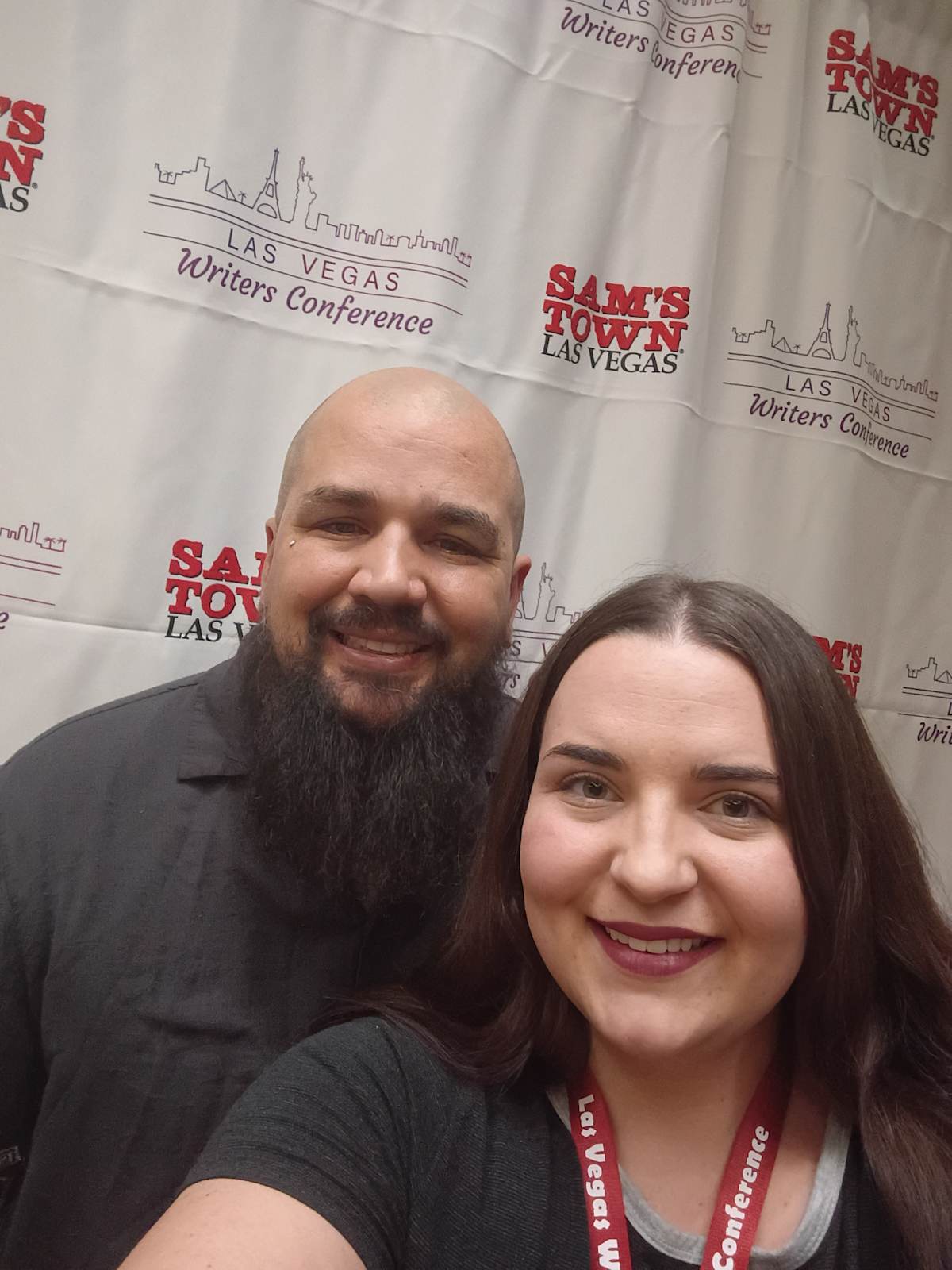
I just got home from the Las Vegas Writers Conference.
I was faculty.
Let me say that again, because my brain is still trying to accept the sentence. I was faculty at the Las Vegas Writers Conference. At twenty-nine years old. Me, little redneck from a town of three thousand people in the middle of rural Utah. Sharing the roster with New York Times bestselling authors, senior literary agents from major firms, talent managers actively developing Broadway musicals, Bram Stoker Award winners, and legacy publishing executives.
The word for the whole weekend was surreal. Not in the dismissive Instagram-caption way. In the actual, dictionary-definition, my-nervous-system-is-not-built-to-process-this way. I taught two sessions (one on sustainable social media for authors, one hands-on workshop where attendees walked out with their own usable content), and at no point during those sessions did the surreality stop. People took notes on what I said. Industry veterans asked me follow-up questions. An author I'd been told about for years walked into my workshop and stayed for the whole thing.
We drove home the morning after, and as we meandered from Cedar City through the long flat stretch up I-15, I started trying to figure out how the hell I got there.
When I got home, I ran the numbers on my career.
The report is exhaustive. It's full of percentages and per-stream payouts and conversion rates, and it tells me, in the cold language of analytics, that my 18.8% social media engagement rate is a massive statistical anomaly outperforming the highest global benchmarks by multiple magnitudes. It tells me that my 802 book sales across nine novels in sixteen months as a completely unrepresented author put me 702% above the industry average for an indie debut. It tells me I am simultaneously a top-percentile creator on certain metrics and a textbook example of strategic problems on others.
The whole document is a study in contradictions. And the more I read it, the more I realized they aren't actually contradictions. They're the same thing the conference was trying to teach me about myself, just in a different dialect.
Because here's what the data is saying: the things that are working are working because of Radical Resilience. The things the algorithm flags as inefficiencies? Also Radical Resilience. The reason I was on that faculty roster? Same answer.
The philosophy isn't separate from the numbers. The philosophy is the numbers. And the conference was where I got to watch it work in real time, in a room full of strangers, instead of watching it work on a spreadsheet.
Radical Resilience is the spine of everything I do. It rests on a handful of beliefs I had to build to survive. The first is that wounds become wisdom when you let them, which is the part most people quote back to me. The second is that you can adapt without erasing the parts of yourself the world keeps trying to rename. And underneath those, the quieter belief that actually holds up the structure: family is something you earn over time, by being the type of person other people choose on purpose.
I built the philosophy because I had to. I've been writing for eighteen years. I left home at fifteen. I was emancipated at sixteen. I've collected enough medical diagnoses to fill a 3-ring binder. Resilience wasn't aspirational for me. It was the air I learned to breathe in, and then it was the only language I had for what I'd survived, and then somewhere along the way it became the work itself.
I never optimized for any algorithm. I wrote and published and posted and showed up because not doing those things felt worse than doing them. And that's also why I taught the way I taught at LVWC. I didn't lecture. I just told the truth about what I'd learned, and what had cost me, and what had taken me years to figure out about staying online without losing my mind to it. The data is now telling me that this approach (which I would call feral commitment to authenticity, and which my report describes more politely as thematic vulnerability) is the engine of every single number that's outperforming benchmark.
And it's also, I now realize, why I was on that faculty roster in the first place.
Start with the engagement rate.
The average Instagram engagement rate in 2026 hovers around half of one percent. TikTok, the gold standard for organic virality, sits at 3.7%. Even elite micro-creators in highly specialized niches cap somewhere between five and eight percent. Mine is 18.8%. The report attributes this to my content being centered on chronic illness, neurodivergence, medical gaslighting, the Wounded Healer archetype, and the Radical Resilience philosophy underneath all of it. It says, with the clinical detachment of a data analyst, that my audience is deeply resonating with my lived experience.
What that actually means in human terms: when you tell the truth about something that hurts, and you tell it with enough honesty that other hurting people recognize themselves in it, they don't scroll past. They stop. They comment. They send the post to someone they love.
That's also exactly what happened in the conference rooms.
I told my story briefly (the way Wendy from the Henderson Writers Group had coached me to in our prep calls: tell it once, hard, don't repeat the beats, trust the audience to remember). And then I taught from it. I watched faces shift. I watched people take notes. Attendees came up to me afterward and told me they'd been waiting for someone to give them permission to do social media this way. The slow way. The human way. The way that doesn't require you to disappear into a brand. The Wounded Healer in real life. Not a metric. An actual room full of people deciding to stay anyway.
The report does flag things that are genuinely problematic, and I want to be honest about those. My streaming numbers are bleeding capital because I'm spreading a hundred and fifty plus song lyrics across the major platforms instead of concentrating promotional energy on a small handful of tracks. My view-to-follow conversion rate is brutal: 0.18%, which means seventy thousand people watched something I made and only 242 of them subscribed to seeing more. My multi-genre catalog is confusing the retail recommendation engines because someone who buys my self-help book and then my erotic romantasy creates a data profile the machine literally cannot categorize.
These are real strategic problems. I'm not going to pretend they aren't.
But here's where I have to disagree with the analysis, gently and firmly. The multi-genre "problem" (as the report calls it) is not a problem I'm willing to solve by becoming a different writer. The reason I write across genres is because I'm a multi-genre human. I cannot in good conscience build a brand that requires me to amputate parts of my creative self to please a recommendation engine. This is Authentic Self-Expression as the actual floor I'm standing on, not as a marketing slogan.
That same refusal is why I think LVWC said yes when they did. The faculty roster needed someone who could speak to indie authors trying to build careers in the modern, fractured, AI-flooded ecosystem. Someone who'd done it, not as theory, but as a stubborn week-by-week practice. The thing that makes me hard to optimize is the same thing that made me the right person to teach what I taught.
And then there's the small number that makes me proudest in the entire report.
Sixty-five newsletter subscribers now.
The analysis correctly notes this is numerically insignificant compared to my social media reach. It's right. Sixty-five is a tiny number when you set it next to seventy thousand views. But sixty-five is the count of people who saw my work, decided they wanted more of it, and handed me their email address knowing exactly what kind of writer I am. They chose to stay anyway. Sixty-five is Found Family in spreadsheet form.
Some of the people who came up to me after my LVWC sessions are now on that list. Which means the spreadsheet number is going to grow because of a few days in a Las Vegas hotel ballroom, which is exactly how Radical Resilience is supposed to work. Wounds become wisdom. The wisdom gets shared. The sharing creates connection. The connection becomes Found Family. The Found Family becomes the only marketing strategy that's ever actually mattered.
The spreadsheet doesn't capture that part. But it captures the residue.
So here's what I think the conference and the report are trying to tell me, together, in slightly different languages.
Being faculty at twenty-nine on that roster on was not a fluke. It was the surface-level visibility of a deeper thing the data is also trying to articulate. The wounds I was told to hide are the engine. The thing I was supposed to apologize for is the thing the institutions are now validating.
The philosophy I built to survive is now the philosophy being rewarded by an algorithmic ecosystem desperate for human signal in a sea of synthetic content. AI-generated work is flooding every digital pipeline. Trust is collapsing. And the thing that cuts through is exactly the thing that kept the LVWC ballroom quiet when I was telling my truth: a real person, real experience, refusing to perform.
The report tells me, also gently, that I have work to do. The streaming strategy needs a serious rethink. The newsletter funnel needs to actually convert the people who are already showing up. I need to stop being precious about my catalog breadth and start helping the algorithms understand who's reading what. The strategic advice is good.
But I'm not taking any advice that requires me to be less of myself. That's the line that held the conference room. That's the line that built the engagement rate. That's the line that earned the faculty seat.
Sixteen months in, with nine published novels and a hundred and fifty plus song lyrics, a small but real newsletter, a wildly engaged social audience, two library systems carrying my books, a brand-new local journalism outlet I am launching, and a weekend in Las Vegas I am still trying to metabolize, here's what I think I know:
The work I was told would not work... is working. The wounds I was told to hide turned out to be the strategy all along.
I'm going to keep building. With sharper data hygiene than I had a year ago, and the same stubborn refusal to perform a less honest version of myself just because the metrics would improve.
The data describes something real. The conference confirmed it in real time. Neither one captures the whole thing. The percentages can't tell you what it feels like to drive home from Las Vegas after a weekend where, for the first time in your professional life, you actually belonged in the room. The benchmark report ends with the phrase strategic realignments. My version of that phrase is keep going.
Sixteen months in, one conference in Las Vegas later, that's what I'm doing.