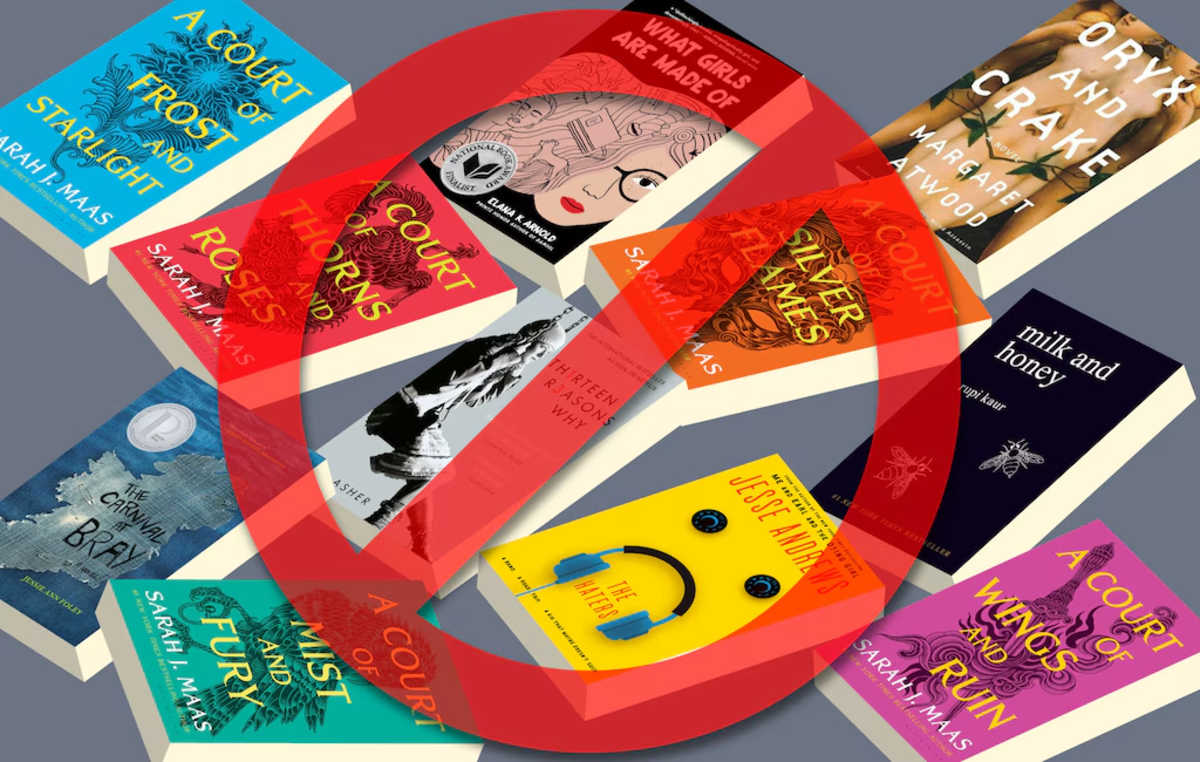
I woke up to learn that Utah has banned more books. Again.
The state now has 22 titles that are officially illegal in every public school library statewide. The newest additions? Wicked: The Life and Times of the Wicked Witch of the West, Nineteen Minutes by Jodi Picoult, and The Perks of Being a Wallflower by Stephen Chbosky.
So naturally, the ACLU of Utah filed a federal lawsuit against the state.
The plaintiffs include the estate of Kurt Vonnegut (whose Slaughterhouse-Five made the list), award-winning authors Elana K. Arnold, Ellen Hopkins, and Amy Reed... and two anonymous Utah high school students. One of those students was sexually assaulted during her freshman year. She went looking for Arnold's What Girls Are Made Of to help process what happened to her. Instead, she found an empty shelf. The book had been banned.
Let that sink in for a second. A teenage survivor of sexual assault tried to find a story that might help her understand her own experience, and Utah's government had already decided she didn't deserve access to it.
This is what we're doing now. This is who we are apparently.
I'm taking this personally because I have to. So many of the books on Utah's banned list shaped who I am. The Perks of Being a Wallflower found me at exactly the right moment in my life (and if you've read it, you know what kind of moment that usually is). I devoured the entire A Court of Thorns and Roses series. I've cried over Milk and Honey. Thirteen Reasons Why was controversial when I read it, but it started conversations that desperately needed to happen. Forever by Judy Blume was one of the first books that treated teenage sexuality like a real thing that real people experience, rather than something shameful to be hidden away.
These aren't obscene books. They're books about being human. About trauma, about love, about sex, about figuring out who you are when the world keeps telling you to be smaller. They deal with hard things because teenagers live through hard things, whether adults want to acknowledge that or not.
Utah's law (House Bill 29, if you want to look it up) defines these books as containing objective sensitive material or being pornographic. The way the law is written, a single sentence describing sexual content is enough to trigger a ban. It doesn't matter if the book won a National Book Award. It doesn't matter if it's taught in college classrooms across the country. It doesn't matter if the passage serves an important narrative purpose. One sentence, and it's gone.
Here's the wild part: Utah law allows sixteen-year-olds to consent to sexual activity. But those same sixteen-year-olds are forbidden from reading a book that contains a description of sexual activity. The state trusts them to make real decisions about their actual bodies, but not to read a paragraph in a novel.
Make it make sense!
The lawsuit names Utah Attorney General Derek Brown, the Utah State Board of Education, and several school districts as defendants. The plaintiffs are asking the federal court to declare the law unconstitutional under the First and Fourteenth Amendments, issue an injunction to stop the bans, and order schools to return the books to their shelves.
This isn't just a Utah problem, even though we're leading the charge in all the wrong ways. Book bans are spreading across the country, and the playbook is the same everywhere: target books that deal with sexuality, mental health, LGBTQ+ experiences, and racial identity. Frame it as protecting children. Ignore the children who are actually harmed when they can't find themselves in any story their school library carries.
One of the student plaintiffs put it better than I can: "For many Utah students, the first place we recognize our own lives and identities is in a library book. When those books disappear, students notice immediately. It sends a clear message about whose stories matter and whose do not."
So whose stories matter? That's what this is really about.
I don't know how this lawsuit will turn out. But I know that empty shelves don't protect anyone. They just make the silence louder. And I'm pissed about it.